

Lapis Light Yoga, let your body find balance in safety
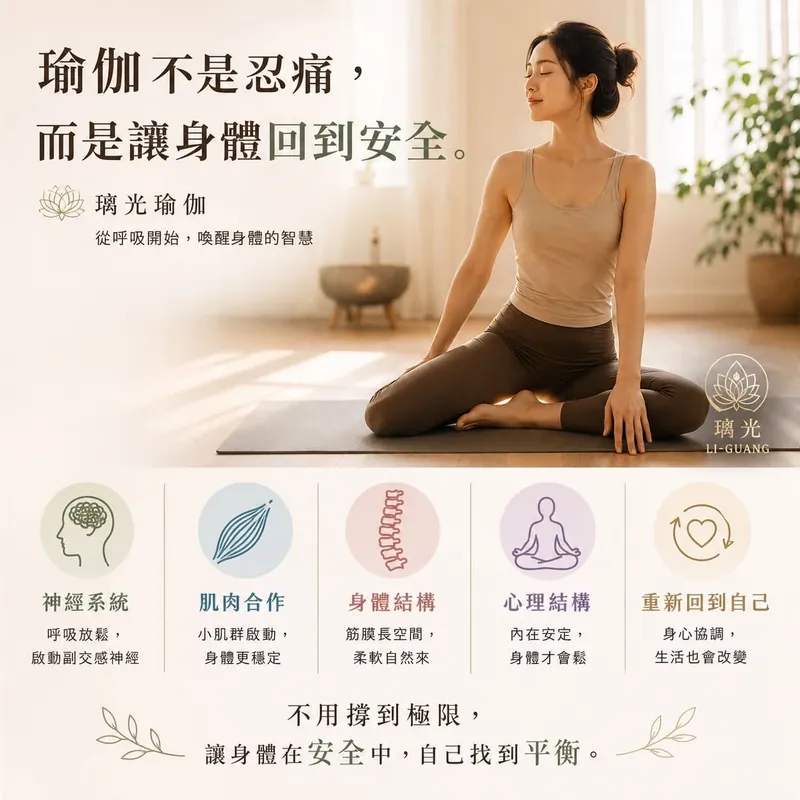
When many students came to class for the first time, they would ask me: "Teacher, is it normal for it to hurt when doing this pose?" Some even told me seriously: "Teachers used to say that pain means there is tension." Every time I hear this sentence, I can't help but wonder, who turned yoga into a endurance competition?
For a long time, many people’s understanding of yoga has been limited to “Lajin”. Later, it gradually evolved into the pursuit of asanas, so the deeper and more beautiful the asanas were, it seemed that the better the yoga practice was. In order to achieve the pose, some people began to press their bodies hard, some began to hold their breath, some began to endure the pain, and some even thought: "Pain is proof of progress."

From the perspective of body structure, muscles have a protective mechanism. When the nervous system senses a threat, the muscles do not truly relax. Instead, they increase tension to protect the joints, tendons, and ligaments. In other words, when you endure pain and deadlift at the same time, what your body really learns is not to relax, but to work harder to protect itself. This is why many people have been doing Lajin for many years, but their bodies are still very tight. Not because of a lack of effort, but because the body never really felt safe.
In recent years, physical therapy, pain science and neuroscience have increasingly emphasized one thing: the flexibility of the body is not just a problem of tendons, but also the nervous system’s judgment of safety. When breathing stabilizes, parasympathetic nerves begin to activate, the body lowers its guard, fascia slides more smoothly, muscle tension begins to decrease, and joints will slowly grow their original space for movement.
So, we won’t ask you to push your body to the limit. What we pay more attention to is letting the body be willing to open on its own.

Lapis Light Yoga is not just about flexibility, we also pay attention to muscles. However, what we train is not to use maximum strength to complete the movement, but to re-establish the cooperation between muscle groups. In fact, many people's bodies are not weak in strength, but the same group of muscles are always working. The shoulders are compensating, the neck is compensating, the lower back is compensating, and the thighs are compensating. The muscles that should really be working are sleeping instead. As a result, the body becomes more tired with more use and the pain increases.
We hope to reawaken those forgotten small muscle groups and let each muscle find its place again. The body is not strong on any one part, but every part knows how to cooperate.
And I think that the real imbalance often does not start from the body, but from within. When a person is anxious for a long time, the nervous system will remain on high alert; when a person is trying to please for a long time, the body will get used to shrinking itself; when a person is afraid for a long time, breathing will become shallower and shallower; when a person suppresses emotions for a long time, the body will slowly lose flow.
Thus, psychology affects the nervous system, the nervous system affects motor control, motor control changes muscle use patterns, and muscle use patterns change body structure. Over time, we think it’s due to poor posture, but in fact it’s often just a lifestyle that slowly develops into the shape of the body.
So, what yoga really wants to restore is never just flexibility, but the coordination of the entire person. Let the breath come back, the nervous system come back, the body come back, the feelings come back, and the consciousness come back to the body. Because only when a person feels his body again can he truly change his life.
When the body learns to relax again, the nervous system learns to be safe again, the muscles learn to cooperate again, and the breath learns to flow again, many postures will actually happen naturally.
Because the real yoga is not to make the body look a certain way, but to let the body finally return to the way it originally knew.
You are invited to click and read: [The Path to Return] Re-establish an inner space of safety, stability and acceptance
If your shoulders, neck and lower back are always tight, or you have been shrinking due to stretching injuries in yoga classes, welcome to Tanya’s Awakening Sanctuary. Let professional teachers accompany you through the coordination and structural restoration of the nervous system, and regain the relaxation and freedom that the body originally knew.
Elena | Founder of Glass Light System
Tanya Awakening Sanctuary Tanya Awakening Sanctuary